
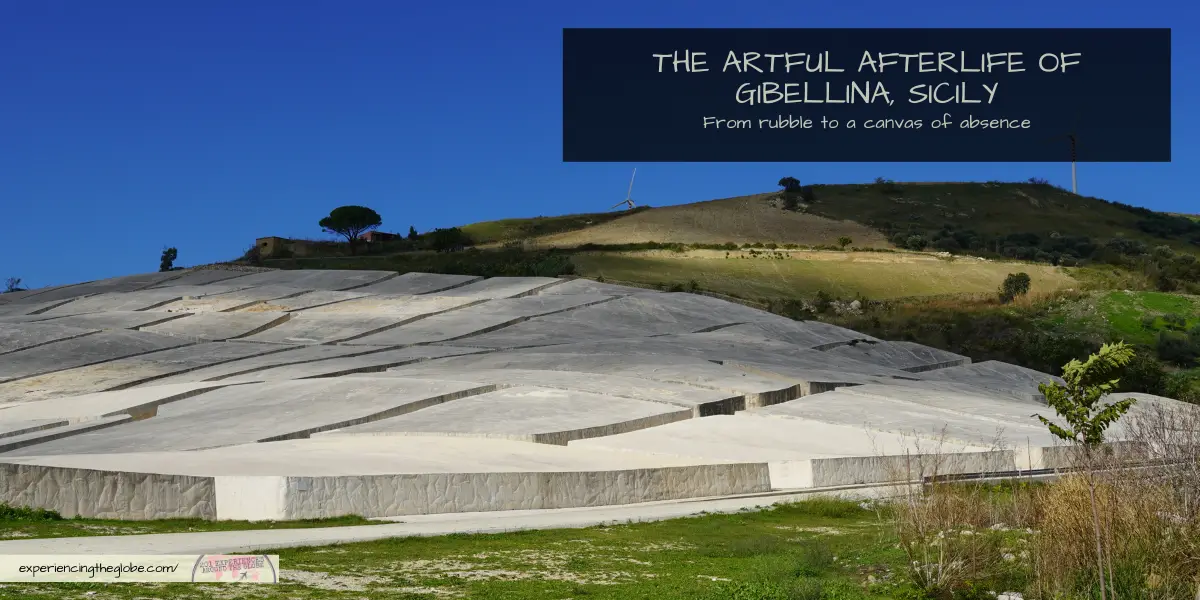

There is a place in Sicily where the ground itself has been fossilized into memory. At first glance, it might look like a modernist fever dream –a concrete veil draped over the bones of a vanished town. But you’re stepping into a ghost’s outline. You are walking not just on paths but through absences, where houses once stood, where dinners were cooked, where lullabies were hummed into sleep.
Gibellina is not a place you stumble upon. It’s a destination that calls softly, insistently, from the edge of Italy’s map and from the rim of comprehension. It’s what happens when a town refuses to be forgotten, and decides, instead, to be reinvented.
Disclaimer: This visit was part of a press trip organized by the West of Sicily Tourism Board. While the experience was hosted, all reflections, words, and opinions are entirely my own.
After the earth moved: the future poured into dust
Sicily is filled with ancient towns, their histories stretching back millennia. But one of them, Gibellina, carries a different kind of story. Not just of age, but of rebirth.
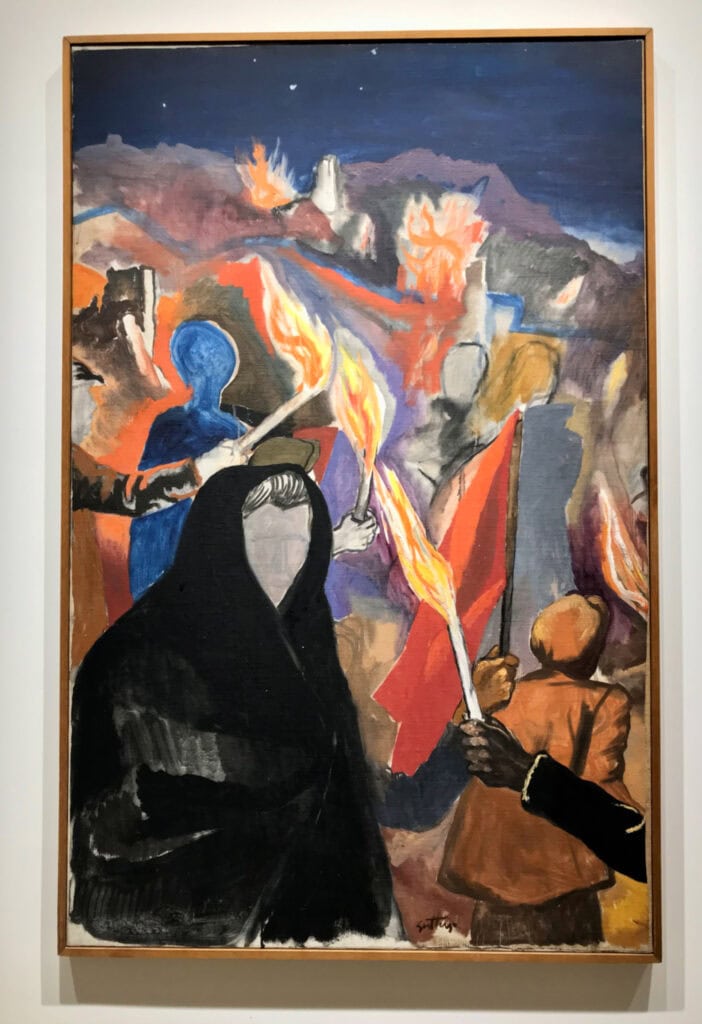
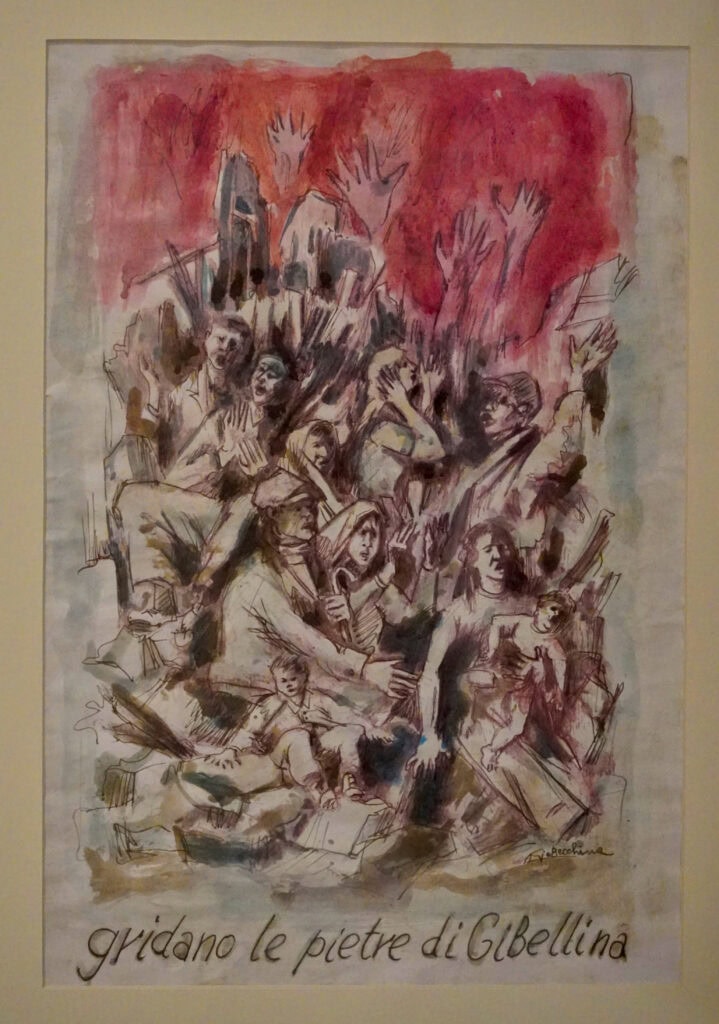
On January 15, 1968, at precisely 3:01 AM, the earth convulsed beneath the Belice Valley, a place lost in the vast Sicilian countryside. The ground opened without warning. The earthquake did not discriminate. It crumbled houses, split time, and cracked open a hole in Sicily’s heart. Gibellina, nestled in the hills of Trapani, was reduced to rubble. In a matter of seconds, it became unrecognizable: a pile of broken stones and shattered lives.
The ‘terremoto del Belice’ was among the strongest to hit Italy, resulting in 231 fatalities in the valley, over 1,000 injuries, and displacing up to 100,000 people.
For years, survivors waited in makeshift shelters, caught between a crumbled past and an uncertain future. But from this devastation arose a radical idea –not just to rebuild, but to reimagine.
It wasn’t restored where it fell. Instead, a new Gibellina was planted like a seed 15km/9mi away –a town raised not with bricks alone but with brushstrokes, sculptures, and radical dreams. The mayor, Ludovico Corrao, envisioned something outrageous: that artists and architects could replace what the earth had taken. Not just a reconstruction, but a resurrection. Something unprecedented.
When a city becomes a canvas: the birth of Nuova Gibellina
The result is not a town in the traditional sense. Nuova Gibellina is an open-air mind experiment, a cracked utopia paved with geometry and idealism. Concrete zigzags like a pulse through its streets. Some doorways lead nowhere. Churches appear as angular ships run aground in fields of silence. And scattered through it all are artworks that wrestle with grief, beauty, and the audacity of beginning again.
It’s a place where you don’t visit sites –you enter conversations.
The entire town is a dialogue between art and space. Streets are lined with oversized sculptures, squares become immersive installations. Nothing is by chance, everything, even the very layout of the town, is a statement.
Over fifty artists contributed, leaving behind a surrealist landscape where buildings defy convention. The Mother Church of Ludovico Quaroni is an angular, almost brutalist structure, challenging the very idea of what a place of worship should look like, stripped bare of ornament, yet heavy with sacred pause. The Civic Tower of Alessandro Mendini, with its kaleidoscope of colors, rises like an impossible dream, standing like a beacon of postmodern experimentation.
In one piazza, the Ingresso al Belice, an abstract steel arch by Pietro Consagra, stands like a gate among worlds –between what was lost and what was imagined, a threshold connecting past and future, destruction and reinvention, a gateway to the town’s second life. In another, the Orto Botanico unfolds as an uncultivated garden: a space where Mediterranean flora grows freely, softening the town’s sharp geometry and offering a quiet, living counterpoint to the visions cast in concrete and steel.

Experiencing the artistry: Museum of Contemporary Art
Beyond its outdoor sculptures and installations, Gibellina holds an indoor treasure: the Museo d’Arte Contemporanea. Not a place of quiet contemplation, but an invitation to encounter art viscerally, with all senses engaged.
I had never experienced contemporary paintings like I did there. I stood before a canvas, blindfolded. One of my travel partners described a painting to me: its movement, its tension, its rhythm. Stripped of sight, I felt art on a different level. The brushstrokes translated into pace, the colors into sensation. The tension between red and black became an argument, the soft gray a whisper of reconciliation. I didn’t need to analyze. I didn’t need to understand. I simply felt.
This is what Gibellina offers –not just art to be seen, but art to be lived.
Elsewhere, in a room of sculptures, the rules dissolved. Touch was not forbidden, it was encouraged. Cold bronze, rough wood, the smooth weight of polished marble –each material held a different memory, a different language of form.
One piece, an installation of suspended glass shards, caught the light in fractured reflections. It reminded me of the earthquake itself –destruction held in delicate balance, transformed into something luminous.


Weaving of cultures: Museum of Mediterranean Patterns
One of the most profound legacies of Gibellina’s transformation is the Fondazione Istituto di Alta Cultura Orestiadi onlus. Founded in 1981, it’s a center for cultural research and artistic expression, drawing creatives from across the Mediterranean. It fosters collaboration between artists, writers and thinkers, continuing Gibellina’s mission of turning tragedy into dialogue.
Housed within the foundation, in the restored Baglio Di Stefano, is the Museo delle Trame Mediterranee. There, the threads of history are literally woven together: textiles, ceramics, and artworks from Sicily, North Africa, and the Middle East form a tapestry of interconnected traditions.
Works by artists like Jannis Kounellis, Carla Accardi and Antoni Tàpies sit alongside anonymous crafts and sacred artifacts, merging the boundaries between the contemporary and the ancestral, the aesthetic and the ethnographic.
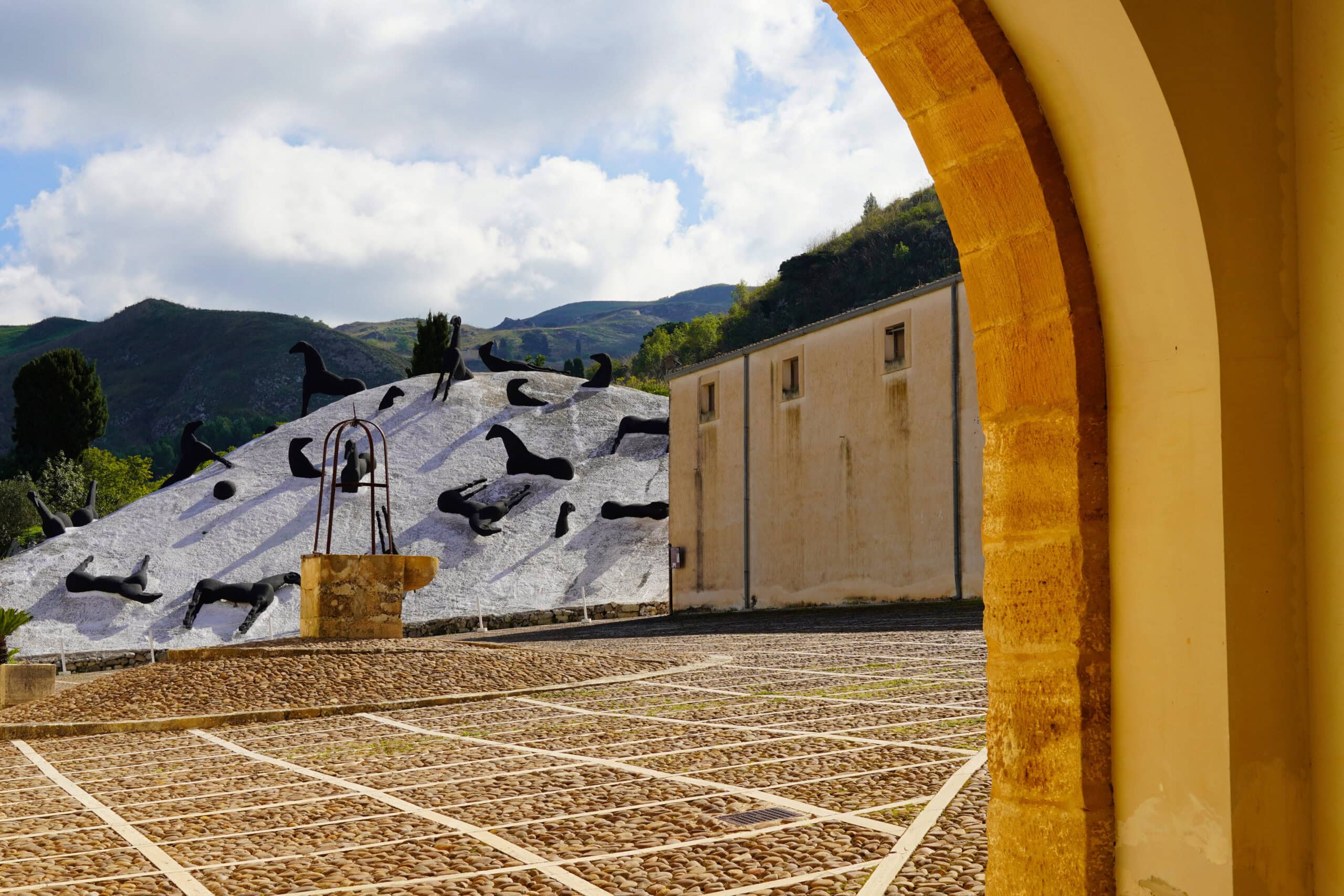
A highlight is Mimmo Paladino’s Montagna di Sale (“Mountain of Salt”), an installation that rises like a mirage: a gleaming mound of Sicilian salt pierced by bronze horses, standing as both relic and riddle. Salt, a substance once prized like gold and used to preserve life, here becomes a metaphor for impermanence: it dissolves, returns to the earth. The horses, ghostlike and motionless, allude to ancient migrations, vanished civilizations, and the stubborn memory of loss. Originally created for the 1990 Venice Biennale and brought to Gibellina during the Orestiadi Festival, the installation serves as a metaphor for the town’s transformation.
The arts center is a reminder that Gibellina’s rebirth was not just about itself –it was about embracing the wider world, about bridging cultures through creativity.
The silence that screams: Grande Cretto
But it’s at the edge of old Gibellina, in a valley of dust, where the town speaks loudest. Most places rebuild in the image of their former selves. Gibellina did the opposite. Rather than resurrecting the old town, it was left as a memory. Instead of streets and squares, it became something else entirely: a monumental artwork.
Alberto Burri, an artist who had once been a prisoner of war, knew something about destruction. He saw in the shattered town a different kind of canvas. Where others saw rubble, he envisioned a vast tomb of memory.
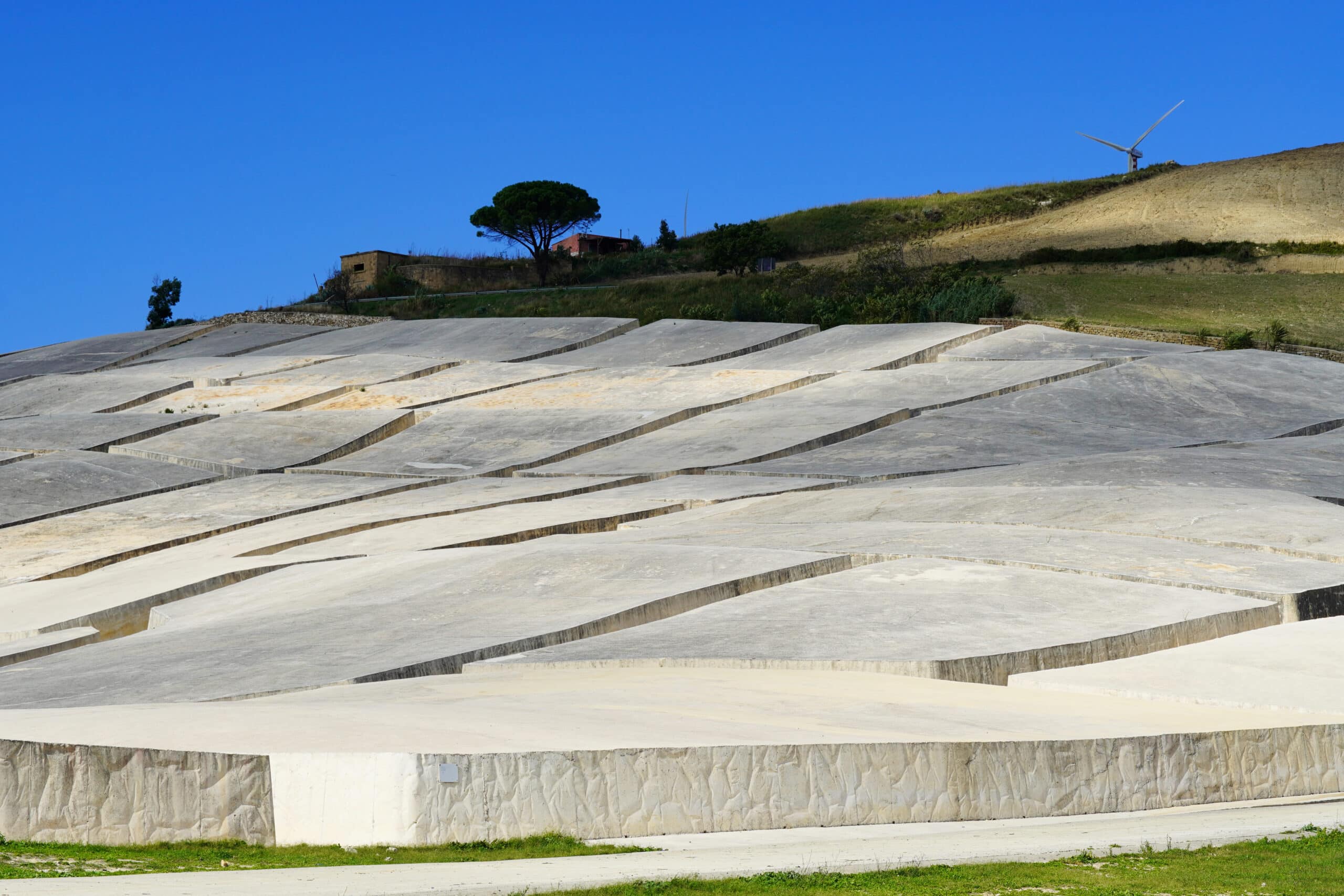
His Grande Cretto covers the ruins like a death veil made of light. Its grid of deep white fissures maps the former streets –a fractured maze that turns the visitors into both archaeologists and mourners. More than 85,000 square meters (915,000 sq ft) of white concrete cover the town’s former footprint, preserving its original layout in a solemn, labyrinthine grid.
But his work doesn’t just memorialize loss, it enters a dialogue with the entire lineage of 20th-century conceptual art. Its cracked expanse resonates with Robert Smithson’s Spiral Jetty, where art meets geology and entropy becomes medium. Like Smithson, Burri understood that decay could be sculptural: time could be a collaborator.
The Cretto also shares conceptual DNA with the Arte Povera movement, which rejected grand materials in favor of the elemental, the earthly, the political. In its scale and silence, the work even anticipates the haunted landscapes of Anselm Kiefer, where memory and ruin are rendered monumental. Burri’s vision was not decorative but confrontational: to make the ground itself speak.
To walk it is to feel the tension between preservation and loss. No plaques explain. No signs instruct. It’s an artwork that resists justification. You enter it not to explore, but to grieve and marvel.
Burri did not rebuild. He did not fill a hole. He outlined it. He made absence visible. And in doing so, he gave the past a body to accompany its soul.
Gibellina, the groundbreaking Italian Capital of Contemporary Art
What happened in Gibellina was never just reconstruction, it was revolution. A forgotten town, shattered by an earthquake, refused to fade into obscurity. Instead, it positioned itself as Italy’s first capital of contemporary art.
The Orestiadi Festival, held every summer, turns the town into a stage for theater, music, and performance. Named after the Oresteia, Aeschylus’ tragic trilogy, the festival bridges classical and modern, history and innovation.
But the art does not disappear when the festival ends. It lingers. New installations appear. Old ones evolve. The town itself is a performance, forever unfolding, expanding its artistic footprint: a dream in progress.

In the desert, flowers
To live in Gibellina is to be part of an ongoing experiment in civic poetry, where walls are not built to contain, but to provoke. Where architecture remembers that it can be philosophy.
Some say Gibellina failed. That its utopian impulse, its harsh lines, its abstract soul, never took root with the displaced neighbors. That the town became a museum before it could become a home. Many residents expressed a sense of disconnection, feeling that while they were offered a vision of the future, it came at the cost of their past. The new town’s concrete plazas and deconstructed forms bore little resemblance to the intimate, communal rhythms that define life in Sicily. The utopia sparkled with artistic idealism, yet it didn’t always root itself in lived memory.
But perhaps that’s the wrong lens. Gibellina was never about comfort. It was, and is, about confrontation. It’s a mirror held to the fragility of everything we build, and a love letter to the idea that beauty might be more than adornment –it might be salvation.
And it’s still dreaming, still asking: what does it mean to rebuild and who gets to decide how memory takes shape?
Ludovico Corrao, the mayor who dared to reimagine a town, left behind these words, that won’t cease to resonate:
“Come to Gibellina, let the flowers of art and culture grow in the desert of the earthquake, of destiny, of oblivion.”
Gibellina is not just a town. It’s a lesson in resilience, a monument to human imagination, an artistic manifesto, an open-air museum where concrete, color, and sculpture whisper the echoes of both ruin and renewal. It proves that even in the face of destruction, something new –something radical– can take root. It could have ended with the earthquake, another town erased by nature’s indifference. But the people of Gibellina refused to let their home become a forgotten footnote.
It’s not for the hurried. It’s not for the casual. It’s for the traveler who understands that some places are not made of stone, but of silence, vision, and refusal. It seeps into your soul, challenges you, haunts you. A place that is and will always be unfinished, constantly shifting: art as a perpetual journey.
WANT TO READ MORE ABOUT ITALY?
- Hiking in Cinque Terre, a sustainable travel guide
- Italy off the beaten path destinations
- Dolomites, winter or summer?
- Venice sustainable tourism: essential tips for responsible travel
- How to visit Pompeii and Mount Vesuvius in one day
- The ULTIMATE Travel Experiences Bucket List
- Rick Steves has a fantastic Sicily guide, if you want to explore more of this amazing island
Liked it? Want to read it later? Pin it!
Enjoyed what you read? A lovely way to show your appreciation is by buying me a cup of coffee 🙂
Your support will ensure I keep bringing you stories and insights from around the world! Thanks so much!


I’ve never been to Sicily, but I love Italy and I love contemporary art so I might just need to put it on my list. Thanks for putting Gebellina on my radar as an art destination!
Thank you, Maren! If you love Italy and contemporary art, Gibellina is definitely worth a spot on your list —it’s such a unique and moving place.
Fascinating – I’ve never heard of this place, but the images are so striking. And the history and the journey of the town and the people are so interesting. Thanks for sharing.
Thank you, Jen! I’m so glad it caught your interest —Gibellina really is one of those places that stays with you, both visually and emotionally.
As a Sicilian, I’m deeply moved by this tribute to Gibellina. The post captures the essence of the town: resilience, beauty and a commitment to memory through art. The Grande Cretto stands as a testament to our past, and the art installations breathe life into our present. It’s heartwarming to see foreigners experiencing, understanding, and falling in love with them. Thank you for sharing our story so thoughtfully and beautifully.
Andrea, thank you so much for your beautiful message —it truly means the world to me. Hearing this from someone Sicilian, someone connected to Gibellina’s story, is incredibly moving. I felt such a deep sense of respect and admiration walking through the Grande Cretto and exploring the town —it left a lasting impression on me.
Gibellina’s ability to turn grief into art, and memory into resilience, is something I’ll never forget. I’m honored to help share even a small part of that story. Grazie di cuore for your words and for keeping that spirit alive ❤️
Wow, I had no idea Gibellina existed until I came across this post! The idea of a destroyed town transformed into an open-air museum is fascinating. The Grande Cretto sounds hauntingly beautiful, and I can’t wait to experience it in person. I’m adding Gibellina to my Sicily itinerary for sure! Thank you for a beautiful post!
Hi Camilla! I’m so glad the post introduced you to Gibellina —it really is one of those hidden gems that leaves a deep impression. The Grande Cretto is unlike anything else: so still, so powerful, and filled with quiet emotion. I’m thrilled to hear you’re adding it to your Sicily itinerary!
Thank you so much for your kind words, and I hope your time in Gibellina is as unforgettable as the place itself! Let me know if you’d like any extra tips before you go 😊
It’s fascinating that they turned the town into an open-air contemporary art museum, after it was destroyed by an earthquake. I get that some of the locals questioned it, it’s actually hard to find a way to remember that everyone will appreciate. But the outcome is brilliant!
Absolutely, Cosette —I felt the same. It’s such a bold and unusual way to process collective memory, and while it wasn’t without controversy, the result is incredibly powerful and thought-provoking.