

This article may contain affiliate or compensated links, and may feature complimentary or discounted experiences. All opinions are my own. Please read the Privacy Policy & Disclaimer for more info.
A note before we begin
Feminism is, at its simplest, the belief in the social, political and economic equality of the sexes. Not the supremacy of women. Not the demonization of men. Equality. This essay is written from that starting point. And also from a position of acknowledged imperfection: I’m a Western woman who has the resources to travel, a passport that opens doors, and a set of assumptions I’m still examining. What follows is a reflection, not a verdict.
Exempt or Exposed? –Foreignness as a Shield and a Target
There’s a particular kind of tension that dissolves the moment you say the right word.
In Iran, that word was khāreji. Foreigner. I learned it quickly –not from a phrasebook but from necessity. Every time my hijab slipped and a man on the street caught my eye and gestured toward my head, I’d point at myself and say it. Khāreji. And immediately the tension lifted. A shrug, a small laugh. The rules still existed. They just didn’t apply to me in the same way.
I spent weeks in Iran being seated in the front row of every bus, close enough that the driver could glance in the rearview mirror and account for me. I was invited into teahouses where no woman sat, and nobody raised an eyebrow. I was an anomaly –and anomalies, it turned out, were exempt. I moved through a country whose rules for women I didn’t have to fully follow, welcomed into spaces I had no right to claim, protected by the very foreignness that in other contexts might have made me a target.
The freedom I experienced in Iran wasn’t mine. It was granted. And the local women–wearing their hijabs correctly, sitting at the back of the bus or not entering the teahouses– weren’t less free than me because of their faith or their culture. The exemption I carried in my passport, in my skin, in my foreignness, simply wasn’t available to them.
That exemption –or exposure, depending on the context– shapes everything about what it means to travel as a woman. Including the question nobody asks clearly enough: safe for whom?
Not safe in the abstract, and certainly not in the simplistic sense of “is this country safe?” –that question, as any woman who’s traveled alone knows, was never really about safety, but about managing the anxiety of the person asking it. The real questions are messier.
Safe from what –violent crime, harassment, the social pressure of being watched and judged and told to cover yourself? Safe compared to whom –the local woman navigating those same streets every day of her life, without a return flight? Safe in what sense –protected by your foreignness, or exposed by it?
The data is stark. Studies in Egypt have found that the overwhelming majority of Egyptian women experience harassment in public –and that foreign women are targeted at an even higher rate. That disparity is the khāreji paradox inverted: the same foreignness that exempted me from dress code enforcement made me more visible, more legible as a target, in other contexts. The exemption isn’t protection. It’s a different set of risks.
We expect danger in certain places and not others, and that expectation is itself a map we inherited rather than drew. A man once hit my friend with his walking stick on a hot afternoon in Marrakesh during Ramadan –startling and unpleasant, though it felt more like irritability than malice. Back in ‘safe’ Europe I’ve been physically harassed in Naples, and someone slipped something into my drink in Belgrade that left me unconscious until the next morning.
I was lucky to be unharmed, but these incidents are a reminder that the places we’re taught to fear and the places where fear actually finds us have very little overlap. The geography of danger for women doesn’t follow the lines on the map we were given.

Solo Female Travel: A Feminist Act Powered by Privilege, Not Just Gender
Who Gets to Take Up Space? Gender and the Geography of Freedom
The solo female travel industry –and it’s an industry now, with its hashtags and its carefully curated narratives of courage– is built on a real thing: traveling alone as a woman is genuinely more difficult than traveling alone as a man. The mental load of it: the constant calculation of which street, what time, which outfit, whether to wear a ring, whether to invent a husband. Research into women’s travel narratives reveals a persistent tension between performing the identity of the strong, independent traveler and the reality of that constant, exhausting vigilance –a tension most women recognize immediately and feel a bit of shame to state out loud.
But there’s something worth examining in who gets to have that difficulty and then write about it and even monetize it as empowerment. Solo female travel is, structurally, a privilege –available to women with passports that open doors and money for the flights, with the particular freedom of not having people at home entirely dependent on them.
Local women around the world are playing by entirely different rules.
In the cafés of small Bosnian, Turkish and Azerbaijani towns, it was plainly displayed in the room: the tables were full of men. Women were not absent from those towns, but the café –public, leisurely, unhurried– wasn’t their space. I sat there anyway. I ordered coffee and nobody asked me to leave, because I was foreign enough to be outside the taxonomy.
In Egypt it was sharper still: entire streetscapes and economies conducted almost exclusively by men. Vendors, passersby, the whole choreography of public life –male. The women were somewhere, but not there. Research into women’s experience of public space documents this as a structural reality, not a cultural curiosity –who gets to occupy public space is a political question.
In rural Peru and Tanzania I watched a different geometry: women working while men held the social identity of provider. The labor was female. The title was male. I watched women carry crops and offer handcrafted goods to tourists with the quiet efficiency of people who’ve learned that their contribution is invisible, even when many of them carry the responsibility of supporting their community.
The women I saw not entering the teahouse, not sitting in the café, working the market stall in the midday heat –they weren’t waiting to be empowered by travel. They were standing inside lives that had never offered them the option.


When Travel Exploits: Power and Privilege in Sex Tourism
And it gets worse. The problem goes far beyond who occupies public space or who gets credit for the labor. The female body itself is the original contested territory. Female genital mutilation, dress codes, abortion restrictions, sex tourism, the normalization of harassment –these are different expressions of the same claim: that someone else has authority over a woman’s body. And although most of these issues are still painfully present in every corner of the world, how we evaluate them frequently comes back to privilege, beyond gender.
Western male sex tourism is one of its most explicit expressions in the travel sphere. Thailand is the case study the world knows. The expansion of sex tourism there is directly traceable to structural choices: agreements between the Thai government and the US military during the Vietnam War established the infrastructure; tourism-focus economic policies created the conditions; and Western travel marketing did the rest.
Researchers note that a major part of why it happens is a specific cultural conditioning: Western males seek “youthful, submissive, enthusiastic, “exotic” girls in order to experience sexual adventures he is unable to pursue at home” while the life of the sex workers are “ruled by impoverishment, exploitation, and a lack of protection from state authorities”.
Japan participates in a quieter version of the same economy –the hostess club industry of Tokyo runs on women performing emotional and social labor for male clients in a system that’s legal, normalized and less scrutinized than its Thai counterpart, because it doesn’t fit the convenient geography of where we locate exploitation.
But this isn’t exclusively male –and feminism demands the honesty to say so. Female sex tourism operates across the Caribbean, The Gambia, Kenya and parts of southern Europe, with local men –frequently young, unemployed or underemployed– acting as “beach boys”. In most documented cases, female sex tourists are middle-aged or older women from wealthier countries, seeking romantic encounters –physical, emotional or both. The power asymmetry is real, and it follows the same logic: wealth, mobility and the privilege of a strong passport moving in one direction; vulnerability in the other. The gender of the person holding the privilege doesn’t fundamentally change the structure of the exchange –though the scale, risks and historical context often differ.
What changes is how we talk about it –or more precisely, how rarely we do. Female sex tourism attracts a fraction of the scrutiny directed at its male equivalent, partly because it’s often framed as romance rather than transaction, and partly because it doesn’t fit the story we prefer about women as the acted-upon rather than the acting. Feminism pushes us to be willing to examine that story too.

None of this is an argument against solo female travel –nor a way of saying it isn’t empowering. It absolutely is. Venturing into a world that was built by men, for men, and claiming space in it anyway is a genuine act of defiance. But defiance and privilege can coexist, and it’s worth being honest about both.
The freedom to travel alone as a woman isn’t a given, it’s a particular convergence of passport, income, circumstance and the specific kind of courage that comes from having options. Not every woman has it. Most don’t. What’s more, a man with no money and a weak passport is less free than a wealthy Western woman. The barrier, it turns out, was never only gender. And the way some of us travel –extracting, moving through other women’s realities without stopping to look– isn’t always so different from the kind of travel we’ve spent decades criticizing men for. Recognizing that isn’t a reason to stay home. Quite the opposite. It’s a reason to go, but to do it differently.
Women in Travel History: Who Gets to Tell the Story?
The history of travel writing is, with some shimmering exceptions, a history of men going places and deciding what those places meant.
The explorers, the cartographers, the colonial administrators who wrote dispatches home, the twentieth century journalists filing from foreign capitals, the television hosts driving across continents –the genre was built by men, for men, about a world that was theirs to interpret.
When women traveled and wrote, they were often remarkable precisely because they were exceptions: Freya Stark navigating the deserts of the Middle East in the 1930s; Isabella Bird riding 800 miles on horseback through the Colorado Rockies and later from Baghdad to Tehran; Dervla Murphy cycling from Dublin to Delhi in 1963, during one of the worst winters in years. If they were celebrated at all, it would be with the condescending attitude reserved for exceptions –as if the achievement needed an asterisk. They did well, for a woman.
What I find most upsetting, though, is not the mere absence of women travelers, but how layered that absence is. Even as women’s travel writing grew, as solo female travel became a genre, the voices that rose to the top were –and remain– privileged ones. Western. English-speaking. University-educated. Traveling on passports that open doors. The blogger writing a safety guide to a place in the Global South. The influencer building a following from countries known for their hospitality. Me, writing this essay.
As scholar Indira Ghose argued in her study of British women travelers in colonial India, female travelers of the imperial era were simultaneously “colonized by gender, but colonizers by race” –transgressing gender norms while serving the same colonial power structure as the men did. We didn’t just carve out space in a world men built, we perpetuated their gaze while doing it.
And that gaze has found a powerful new vessel. The contemporary travel influencer who photographs an elder woman, writes a caption about her beauty or her unbelievable spirit and moves on –gaining followers or brand deals– is performing a version of the same extraction that colonial travel writers performed with a notebook. The subject of the photograph didn’t consent to becoming content. Her image circulates, generates engagement, perhaps earns money, while she remains exactly where she was. The Instagram economy has made this kind of extraction frictionless and invisible –because it looks like admiration, and admiration feels like the opposite of harm. But it isn’t always.
Local women don’t just experience travel differently –they’re largely absent from the story of travel itself. Not as subjects, not as the beautiful stranger in the photograph or the resilience tale in the caption. But as narrators. As people with fully formed perspectives on what it means to move through their world. The tourist guide in patriarchal societies who fought to do a job that raised eyebrows in her own country knows more about navigating the geography of being female in that place than I could observe in a week following her around. I listen as much as I can. But I still write the story. The point is not to stop writing. It’s an invitation to hold the pen differently.


The ‘Savior Complex’ Rooted in Colonialism: When Western Feminism is Too Self-Righteous to Even Listen
Who Are You Saving? Deconstructing Western Feminist Narratives
At some point –I’m not sure exactly when– mainstream Western discourse developed a particular relationship with the Muslim woman. She became a cause, a problem to be solved by people who’d never met her.
The burqa, the niqab, the chador, the hijab –these became shorthand for oppression in Western political narrative, and by extension in Western travel conversation: symbols doing the work of an argument, without nuance. You see a woman fully covered on a street in a European or North American city and something tightens in the liberal progressive chest. An injustice, legible at a glance. The response comes quickly, because it’s been rehearsed: this is backwards and we must fight against it.
What gets skipped, in the speed of that response, is the woman herself.
I’ve met covered women who experience their dress as faith and identity, as a choice made in full awareness of the alternatives. I’ve met covered women who experience it as coercion, as something imposed on them by fathers and husbands and community pressure. I’ve met covered women who hold both of these things simultaneously, in the complicated way that humans tend to hold the things that shape their lives. But I’ve never met a covered woman whose situation was improved by a Westerner’s outrage on her behalf.
As law professor Amal Idrissi puts it plainly when discussing women’s rights in Morocco: it’s not religion holding women back. It’s patriarchy. That distinction matters enormously –because attacking religion is not only inaccurate, it’s counterproductive. It alienates the very women whose solidarity you claim to seek, positions Islam itself as the enemy rather than the structures of male power that exist across every faith, and lets Western feminism feel righteous without examining its own patriarchal structures. France banning the hijab in public spaces isn’t a feminist act. It’s a different set of men making a different set of rules about what women may wear, and calling it liberation.
This pattern extends beyond the veil into every arena where Western eyes meet non-Western women’s lives. Restricted access to education, exclusion from political life, normalization of sexual violence –these are real and urgent injustices, and naming them matters.
Afghanistan is the sharpest possible example of what happens when the logic of “women’s bodies as political territory” reaches its endpoint. Since the Taliban takeover in 2021, nearly 2.2 million girls have been banned from secondary and higher education, making it the only country in the world where this is state policy. In 2021, an Afghan woman could have run for president. By 2025, a Taliban edict declared public speaking by women a moral violation. Four years. From candidate to silenced.
But naming is only the beginning, not the work. The real impact requires following the lead of the women living inside those realities, funding their organizations, amplifying their voices, and sitting with the discomfort of being told that your framework doesn’t fit.


Following Her Lead: Supporting Women on Their Own Terms
The concept gender apartheid was first articulated by Afghan women human rights defenders, in response to the Taliban’s first takeover in the 1990s. UN experts have since warned that Taliban edicts, policies and practices constitute an institutionalized system of discrimination, oppression and domination of women and girls that amounts to apartheid –and that existing legal frameworks, including gender persecution, do not fully capture the institutionalized and ideological nature of what is happening there.
An international campaign is now pushing for gender apartheid to be codified as a crime against humanity under international law, with a UN treaty process formally beginning in January 2026. The term matters because naming a crime is the first condition of prosecuting it, and because, as Afghan lawyer Azadah Raz Mohammad told the UN Security Council in March 2025, “no term better describes the crimes the Taliban are committing against Afghan women and girls”. She said it. Not us. That distinction, again, is everything.
The distinction also speaks loudly in Iran. In 2022, Iranian women took to the streets in the Women Life Freedom movement, removing their hijabs at extraordinary personal risk, leading their own revolution against a regime that has since cracked down with arrests, violence and fear. They didn’t ask for Western women to march on their behalf. They asked for something more specific and more difficult: international pressure on the regime and attention that doesn’t evaporate when the next news cycle arrives.
I met a young woman in Iran –I’ll call her Rooyan, though that is her real name and she has never asked to be hidden. She taught herself English, methodically, planning to eventually be able to immigrate. She took off her hijab any chance she had, with the particular defiance of someone who knows the cost of each small act, even at her young age. She spoke about the system that trapped her with a clarity and fury that left no room for pity, only respect. She is now studying at university –because Iranian women do have access to higher education, university campuses are inhabited equally by both genders, a fact that complicates the flat narrative of total oppression that Western discourse prefers.
What Rooyan needed was connection, understanding, the knowledge that people outside were watching and would not look away. The difference between the savior fantasy and genuine solidarity is exactly that: the willingness to ask what is needed, and to show up for the answer even when it’s inconvenient, long-term and not photogenic.
In the shadows of Cairo, in its Garbage City, I found something that reframes what visibility can do when it’s done right. The men collect the trash of the city. But the women are the heart of the operation: sorting, categorizing, managing, transforming. A group of them founded APE (the Association for the Protection of the Environment) an NGO that offers employment programs, literacy and education projects, recycling workshops and environmental outreach. Their crafts, made from recycled materials, support both livelihoods and sustainability, some reaching international clients and high-end fashion brands. These women aren’t waiting to be saved. They built something that is empowering.
There are examples like this everywhere –women turning invisible labor into visible power, in contexts where nobody expected them to. The traveler’s job is to find them, name them correctly, and point toward them rather than toward themselves.

The ‘Third World Woman’: A Story the West Tells Itself
What masquerades as feminism in the savior instinct is something less flattering. Postcolonial feminist scholars –most influentially Chandra Mohanty in her foundational essay Under Western Eyes– have argued for decades that Western feminism tends to construct a monolithic “third world woman”: victimized and voiceless, waiting to be saved. This construction positions Western women as the subjects of feminism: the ones with the answers; and non-Western women as its objects: the ones with the problems. Solidarity claimed from that position is simply charity. It’s the rescue fantasy dressed in progressive language, and it has the same colonial structure as everything it claims to oppose.
Colonialism didn’t end when the flags came down, it adapted. One of the new branches is filled with travelers telling someone else’s story. It travels light: a carry-on bag, a camera and a following. It doesn’t need a government behind it or a territory to claim. It operates through attention –who gets to look, who gets to narrate, whose experience becomes content and whose becomes context.
The question isn’t whether to speak –silence isn’t neutrality, and choosing not to engage is its own kind of erasure. The question worth asking, every time, is whether you’ve done enough listening to have earned what you’re about to say, and whether the woman whose story you’re telling would recognize herself in it.

What’s Truly Worth Praising –And Why That’s Not the Same as Romanticizing It
There’s a version of the following observation that slides into condescension. You know the trope: the traveler returns from some humble village and declares that the people there are so happy, so connected, so much richer in the ways that matter. It’s a way of feeling good about what you saw without thinking hard about what caused it or whether the people living it would choose it if they were given other options.
But there are lessons we can take without romanticizing poverty and hiding hardships.
In several of the societies I’ve been able to observe and research, particularly those organized around matrilineal or communal structures, I saw something that functions better than what I know at home. Not in some vague spiritual sense –structurally.
The Minangkabau of West Sumatra –the world’s largest matrilineal society, around four million people– are Muslim. I mention this not as a contradiction but as a correction to a reflex. Their matrilineal customs and their Islamic faith coexist without conflict. Property passes through the female line, senior women are revered, decision-making is by consensus, and the society exhibits notably low levels of violence and conflict.
The Mosuo of southwestern China practice what they call walking marriages: no cohabitation, children raised within the mother’s extended family, with brothers and maternal uncles in the fatherly role. The community is stable. Children are held by a web of adults rather than suspended from one or two.
The Maasai women I sat with in Tanzania spoke about polygamy in terms that reorganized my assumptions: multiple wives meant shared domestic labor, joint childcare, company and mutual support. It wasn’t a Western feminist arrangement. It also wasn’t, straightforwardly, the opposite of one.
I’m not arguing that these societies have solved what we haven’t, full stop. Patriarchy takes many forms and most of them were present. What I’m saying is that some of what they’ve built –specifically around the collectivization of care– contains something worth taking seriously rather than romanticizing. Collective childcare isn’t charming folklore. It’s a structural answer to a structural problem. Women have more freedom when care stops being a private burden. That’s observable, it’s documented and it has political implications for every society, including the ones that consider themselves most advanced.
The distinction between romanticizing a culture and identifying something it does better is worth holding onto. The former is about the traveler’s feelings. The latter is about listening and learning.
What Feminist Travel Should Look Like: Learning to Listen
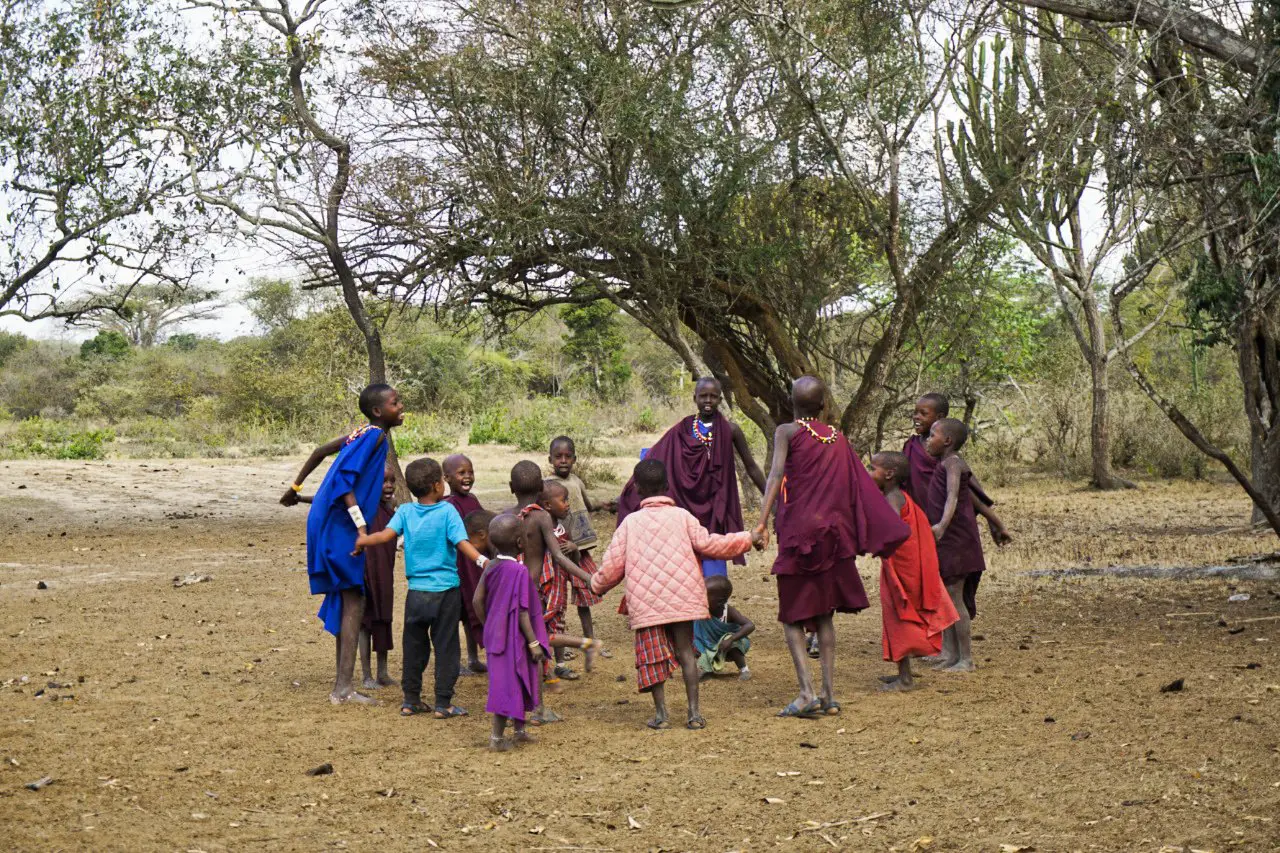
I asked Yayai, the matriarch of a Maasai family I spent a week with, what message she’d like to send to the world about her way of life.
She heard the question in translation. She looked at me for a long moment. And then looked back at her daughter-in-law doing the translation, with an expression I’ve thought about many times since –not confused, exactly, but somewhere between puzzlement and patience, the look of someone being asked a question that doesn’t quite make sense.
She didn’t have a message for the world. The world, as a thing separate from her life, wasn’t a category she could work with. She knew what makes her happy and what hurts her. She knew the texture of her days, the weight of her responsibilities, the warmth of the children who moved through her home, the way to care for her animals. She didn’t know, because she had no reason to know, what was different about any of this elsewhere. She had no other life to compare it to.
I’d traveled across a continent to ask her to translate her existence into terms useful for my readers. The blank look was the correct response.
I always ask questions –it’s constitutive of how I move through places. But that moment in the Maasai boma taught me something that all my careful questioning hadn’t: the premise of a question isn’t neutral. When I ask a woman what she wants the world to know about her life, I’m assuming she experiences her life in relation to the world, that the comparison I’m inviting her to make is one she finds meaningful. Sometimes she does. Sometimes the question lands like a stone in still water and tells you more by what it disturbs than by any answer it receives.
On the other hand, Lujain, my guide in Syria, knew exactly what she wanted to share with the world. She said it without being asked, matter-of-factly, between sites: that she’d fought for her job, that her family hadn’t been pleased, that she longs for people to understand her country better, and to see the world herself someday. She didn’t need the question. She’d already written the answer.
Some women don’t need to spell it out. They showcase it. In El Alto, Bolivia, the wrestling Cholitas took a space that was never built for them and made it completely their own. Watching them perform amid colorful skirts and theatrical fury, I understood something about female strength that didn’t look like anything I’d been taught it was supposed to look like. It wasn’t subtle or waiting for permission. It was loud and collective: not a structural arrangement but a cultural performance of power, entirely on their own terms.
What connects these three encounters is proximity –the kind that’s only possible by immersing yourself in different cultures. If a tradition runs against what I believe, I want to see it, understand why it persists, and have a more informed basis for whatever position I take. That’s not the same as accepting everything I see. It’s the difference between a position built from experience and one built from assumption –and it requires staying long enough to have the assumption dismantled.
→ You can reach Lujain directly if you’re planning a visit to Syria, this is her Instagram account.
→ If you want a firsthand account of life in the Maasai community, Stephanie, Yayai’s daughter-in-law, wrote a wonderful memoir: “Masai Story: My Fight For Love and The Future Of Indigenous People“. You can also follow her on Instagram.
→ The Wrestling Cholitas perform every Wednesday and Sunday in Coliseo Villa Dolores in El Alto, Bolivia.


How to Travel as a Feminist: An Incomplete Practical Guide
I don’t think there’s one clear answer: feminist travel isn’t a certification you earn or a checklist you complete. What I can offer instead are some working principles, drawn from years of traveling, from research, from wrong questions asked in good faith, and, most importantly, from the women who corrected me when I needed it.
Pay local women properly and avoid haggling. The most direct transfer of power available to a traveler is economic. Seek out women-led guesthouses, tour operators, guides and artisan businesses –not as a novelty but as a default. Platforms like Kiva offer more structural ways of supporting women’s economic agency; while Host a Sister and Couchsurfing make it possible to meet local women in places where casual encounters in public spaces are difficult or even impossible, building connections that outlast your stay.
Before you arrive somewhere, read something written by a woman who lives there. A novelist, a journalist, a poet, an activist. When you write or talk about what you saw, ask whose voice is centered. If it’s yours, ask why –and what it would take to shift it.
When you photograph someone, ask permission. When you publish that photograph, name her if she’s agreed to it, link to her business if she has any, and write a caption that’s about her rather than about how seeing her made you feel. The difference between documentation and extraction is often just that: whose name is in the caption. It’s harder than it seems, but it can make an impact in her life.
When you encounter something that troubles you –an inequality, a restriction, a dynamic that feels unjust, a tradition different to the ones you know– resist the reflex to diagnose. Ask instead. Stay with the discomfort of complicated answers and allow them to change your mind.
Be honest about what you are: a person moving through the world with a particular set of advantages, a passport that opens doors others can’t open, the ability to leave. That’s not a reason for guilt but a source of responsibility. The freedom you carry is structural. Use it structurally, in ways that extend beyond your own experience, beyond the story you’ll tell when you get home.


Closing Thoughts: Back to the Teahouse
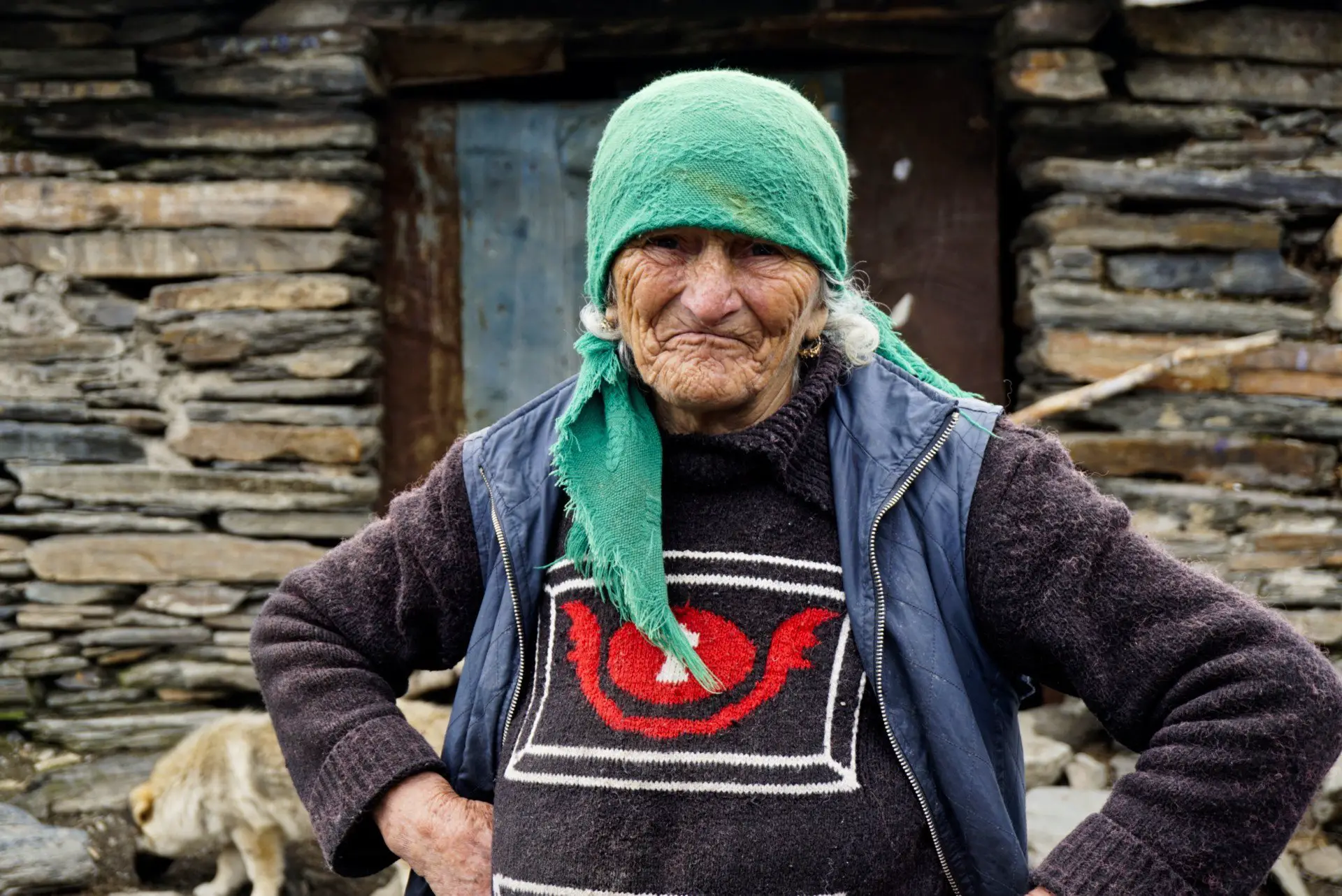
I still think about the teahouse in Tabriz.
The man who invited me in wasn’t making a political statement. He was curious about a foreign woman traveling alone, which was unusual enough to override the usual rules. I drank the tea. I answered his questions –where are you from, are you married, why are you here alone– and asked some of my own. I was, for that hour, free in a way that no local woman could have been.
Outside, the street continued as it always had. The rules still applied to everyone they had always applied to. My presence in that teahouse changed nothing.
But I don’t think the answer is to not enjoy the freedom of sitting there. Nor is silence, or the performance of humility that keeps you so busy examining your own privilege that you never actually do anything with it. That’s just another way of making travel experiences about yourself.
Feminism –the belief in equality, still unfinished, still necessary– is not the Instagram caption about a local woman or the safety guide or the empowerment narrative, though those things can be part of it. It’s something quieter and more demanding: the willingness to arrive somewhere as a student rather than an authority, to spend as much energy listening as narrating, to ask what your presence costs as well as what it offers.
I still put my hijab on loosely, the way foreigners do. I’m still learning which questions translate. But I’ve stopped believing that the miles alone mean anything. What matters is what you bring back –not in your suitcase, but in whether your presence in a place left something of value or only took.
In the teahouse, somewhere between the first cup and the last, I’d managed to unlearn something. That my presence in a space is not the same as understanding it. That witnessing another woman’s life –however closely and carefully– doesn’t give me the right to narrate it. That the most useful thing my privilege can do is create room for voices that have always been there, waiting not to be rescued but to be heard. And that, I’ve decided, counts as an excellent day of travel. So I stepped back outside and went looking for the next question.

Special thanks to my soul sister Maja Penry-Ristanović, whose experiences and thoughtful feedback helped shape this essay.
What to read next
- Geopolitics of Travel: Insights Beyond What the Media Portrays
- Does Your Place of Birth Determine Who You Are? A Reflection on Tourism, Migration and Globalization
- Volunteering in Africa: White Saviorism, Orphanage Tourism, Aid Dependency, and a Safari
- Shadows of Egypt: from the New Capital to Cairo’s Garbage City and City of the Dead
- Visiting Transnistria: The Soviet State that Lives On, But Isn’t on the Map
- Traveling to Syria: Insights on Visiting Under the al-Assad Regime
Liked it? Want to read it later? Pin it!


Enjoyed what you read? A lovely way to show appreciation is by buying me a coffee.
Your support keeps the stories, guides and geopolitical insights coming. Thank you so much!


I have always considered myself a feminist but it never crossed my mind to think whether I was traveling as one. I love love love that you made me question it, and even more that you gave practical advice on how to improve. This is the kind of writing that will never allow AI to replace humans. Thank you so much, Coni!
Awww, thank you so much for your lovely words, Hannah! I’m so glad to hear the essay helped you -just for that it was worth writing it.
Hi Coni, there is truly so much to say about this piece, something that could only be expressed over a nice cup of tea and endless time for deep conversations. So, for now, I will say thank you for this wonderful piece of travel writing. It is the kind of article that makes me dig deep to remind myself that the work I do on my journey of intersectional feminism is never done. I studied tourism in my environmental science grad school program, and I often looked at the inequality, the gender power dynamics, and the sex tourism, and hearing these stories from you brought some of that to life. Thanks!
Thank you so much for your beautiful comment, Susanna! I hope our paths cross in life and we get to have a long talk over a hot cup of tea.